The Ministry of Internal Affairs (МВД), Russia’s federal law-enforcement agency, reported an inspection at a school construction site in Saransk: the contractor employed 40 foreign nationals without the required work patents. The total fines imposed amounted to 14 million rubles. The report does not introduce new rules or specify new deadlines, but it documents a specific enforcement practice on a construction project.
What happened at the school construction site
The violation was identified at a school construction site in Saransk. According to the Ministry of Internal Affairs, 40 foreign nationals who did not have the required work patents had been employed. This was not a single incident involving an individual employee, but the employment of a significant number of people within one construction project.
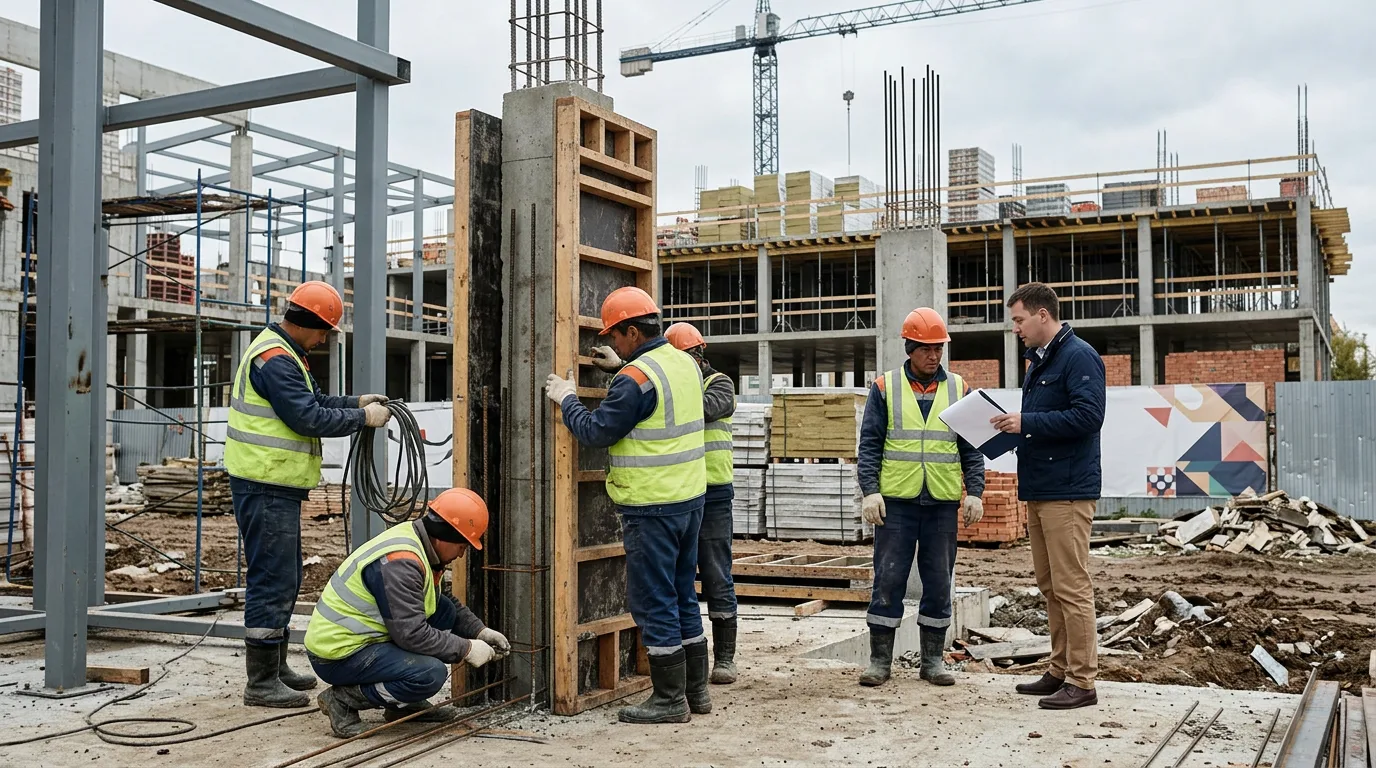
The foreign nationals performed welding and concrete work, installed formwork, and tied rebar. This example is important for the contractor because the inspection covered workers performing different production operations. Document checks cannot be limited to just one occupation or one area of the site.
What financial outcome was reported by the Ministry of Internal Affairs
The contractor was fined a total of 14 million rubles. This is the only amount stated in the original report. It does not disclose the calculation of fines for each worker, the individual decisions imposing the fines, or other circumstances that affected the final amount.
This amount cannot automatically be used as a forecast for another company or contract: the published material contains no data that would make it possible to calculate the consequences in a different situation. However, the case itself shows that allowing workers without the required work patents to work can create a significant risk for a contracting organization.
Where the key control point arises in the hiring process
A practical solution for an employer is to check whether a foreign national is required to have a work patent before allowing them to work. In the case described, checking after the workers had actually started working at the site no longer prevented the consequences: the Ministry of Internal Affairs reported fines for employing workers without the required documents.
For a construction contractor, it is useful to separate checking the right to work from assigning tasks. First, establish whether a particular worker needs a work patent, and then verify that the worker has one. Only after that can the issue of allowing the worker to perform welding, concrete work, formwork installation, or rebar tying be considered within the company’s internal processes.
Why a unified approach matters to a contractor on a construction site
Dozens of people may be employed on a construction site, performing different types of operations. At such a site, the risk increases if documents are not checked according to a common procedure but only periodically—for example, only when part of the workforce is hired or only for certain crews.
The original report does not describe the contractor’s internal organization or establish a mandatory control model. However, it provides a clear point of reference for management decisions: possession of the required work patent should be verified before a foreign worker is actually allowed to work, rather than assessed after work has begun.
What is known about the rules and what the report does not say
The Ministry of Internal Affairs did not report any new requirements or changes to legislation in connection with this case. The publication concerns a specific inspection and its outcome: 40 foreign nationals were working without the required work patents, and the contractor was fined 14 million rubles.
The original data also do not specify new deadlines, additional documents, the procedure for remedying the violation, or special obligations for the construction customer. Therefore, a company should not supplement this case with unconfirmed conclusions. In case of doubt, it should consult the Ministry of Internal Affairs’ current official guidance.
What to check
- Establish whether a particular foreign worker is required to have a work patent by checking the official requirements.
- Before allowing a foreign national to perform construction work, verify that they have the required work patent.
- Check documents before the worker starts working at the site, not after work has begun.
- Do not apply the amount of 14 million rubles to other situations: the report does not provide the method used to calculate it.
- In case of doubt, use the Ministry of Internal Affairs’ current official materials.