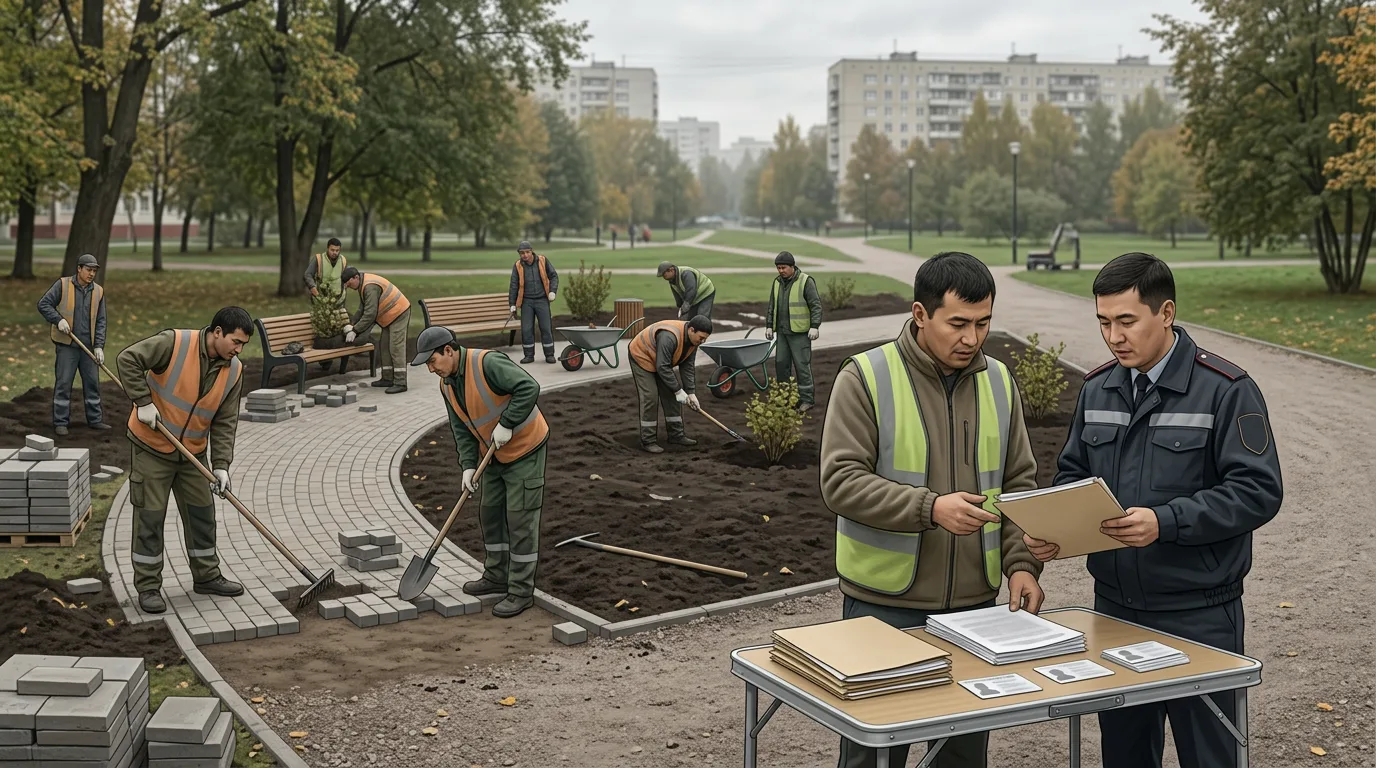
The Russian Ministry of Internal Affairs (МВД России), the federal agency responsible for migration and law enforcement matters, reported a court decision involving an organization that engaged foreign nationals in landscaping a park in Kursk. According to the agency, 11 people worked as general laborers without work patents or permits. The total fines imposed on the organization amounted to 2 млн 750 тыс. rubles. This is not a report on new regulations: it concerns the outcome of an inspection and the liability applied in a specific case.
What Happened During the Park Landscaping Work
Foreign nationals were engaged as general laborers in landscaping a park in Kursk. The Russian Ministry of Internal Affairs stated that 11 workers did not have work patents or permits. The material does not specify the organization’s name, the workers’ citizenship, the period during which the work was performed, or other circumstances of their employment arrangements.
The case ended with a court decision: the organization was given administrative fines totaling 2,75 million rubles. For an employer, this illustrates that documentation for foreign personnel matters not only when arrangements with a worker are made, but also when the worker is actually allowed to perform tasks.
Why Document Checks Cannot Be Postponed Until Workers Reach the Site
In the situation described, the foreign nationals were already working as general laborers. Therefore, checking the required document should be part of the process before engaging a person to work, rather than an action taken after the person arrives at the site. The Russian Ministry of Internal Affairs specifically identified the absence of patents or permits as a circumstance connected with the fines imposed.
In practice, this means that the employment process needs a separate control point: a worker must not be allowed to work until the document required in light of the worker’s status has been checked. The publication does not disclose the status of each of the 11 foreign nationals or which specific document was required for each person. These circumstances should be determined based on the official requirements of the Russian Ministry of Internal Affairs, rather than on a general assumption.
How an Employer Can Structure the Check
The check should not be limited to an oral confirmation from the candidate or line manager. The employer should consult the Russian Ministry of Internal Affairs’ official requirements for the documents of the specific foreign worker and determine whether that person needs a work patent or work permit. Only after that can the possibility of engaging the person in work be assessed.
This is particularly important where personnel are assigned to a site through several participants in the process: the client commissioning the work, the contractor, the HR department, and the on-site manager. The Russian Ministry of Internal Affairs’ material does not establish rules for such arrangements or specify the duties of individual participants. However, it demonstrates a management risk: the absence of a verified document held by engaged workers may result in a court-imposed fine for the organization.
What Is Known About the Consequences and What the Report Does Not Say
There is one confirmed consequence: the court imposed fines of 2 млн 750 тыс. rubles on the organization for engaging 11 foreign workers without patents or permits. The publication does not make it possible to determine the fine per worker, because only the total amount is stated. It also does not report whether any other measures were imposed.
The Russian Ministry of Internal Affairs did not announce new rules or changes to legislation. No special deadlines for checking documents, deadlines for remedying violations, or document validity periods were specified. Therefore, an employer should not view this news as a change to the hiring procedure: it is an example of enforcement practice that emphasizes the need for preliminary documentary checks.
What to Check
- Before engaging a foreign national to work, consult the Russian Ministry of Internal Affairs’ official requirements for documents, taking the person’s status into account.
- Check whether the worker has a work patent or work permit if such a document is required for that specific worker.
- Record the check before the person is actually allowed to perform the work.
- Do not replace document checks with an oral confirmation from the candidate or the on-site manager.
- Bear in mind that the Russian Ministry of Internal Affairs’ report does not specify special deadlines or additional checking requirements.