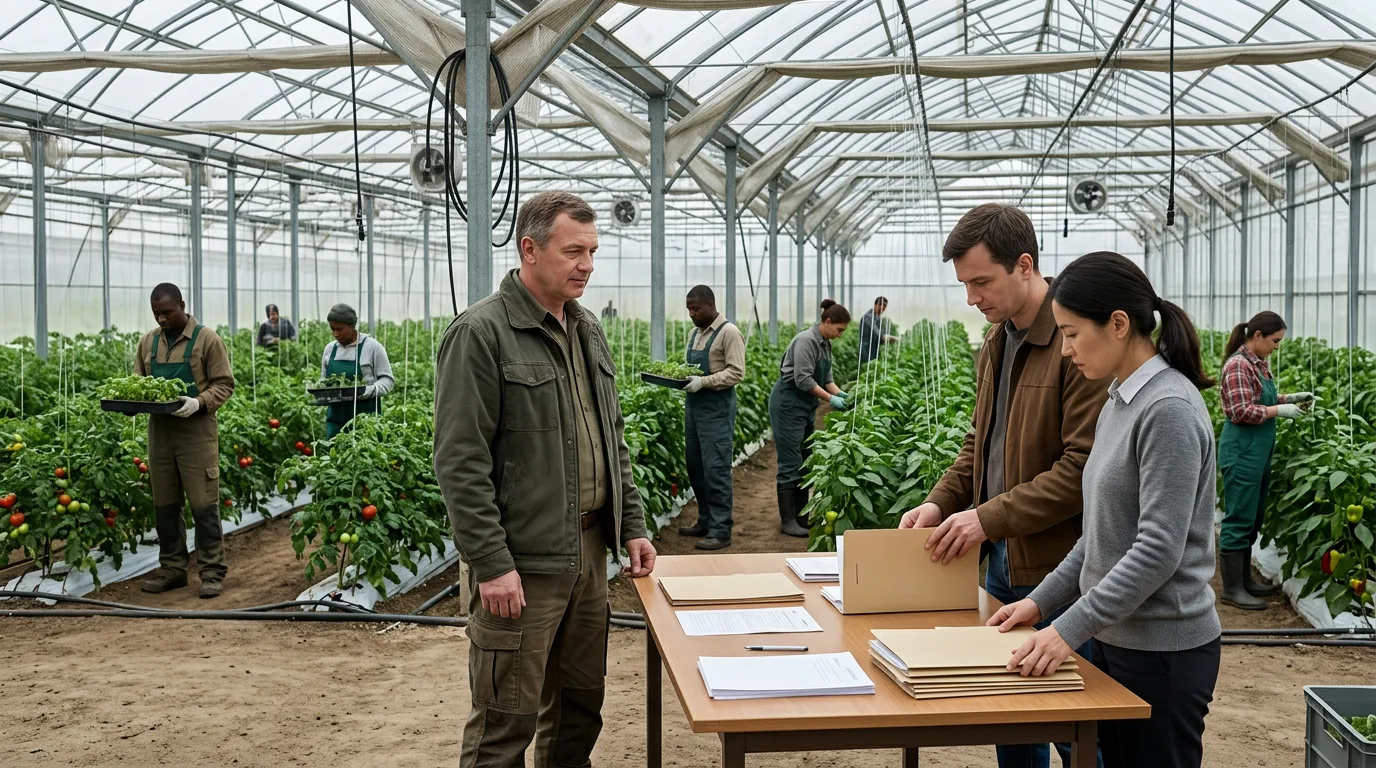
Russia’s Ministry of Internal Affairs (Министерство внутренних дел Российской Федерации, МВД; the country’s federal law-enforcement agency) reported a case in the village of Chernorechye, Volzhsky District, Samara Region: at a greenhouse complex, 58 foreign nationals performed agricultural work without the permits required for such activities. The total fine imposed on the entrepreneur was 7 million rubles. This is not a report about new rules: the original material describes enforcement practice in a specific case.
What happened at the greenhouse complex
An inspection found that foreign nationals had been engaged to work at the greenhouse complex. The issue concerned agricultural activities specifically, rather than people’s mere formal presence at the site. According to the Ministry of Internal Affairs, 58 workers lacked the permits required to perform this work.
For businesses, this case is significant because of the scale of the consequences: the number of workers engaged and the absence of the required documents resulted in a total fine of 7 million rubles. At the same time, the material provided does not disclose exactly which permits were missing for each person or how the amount was calculated for the individual violations.
Why a personnel check must come before allowing work to begin
The key management control point is before the person actually starts work. If a foreign national has already been allowed to perform tasks but the documents required for the planned activity have not been verified, the employer assumes a risk that is difficult to eliminate later through internal explanations or corrections to personnel records.
The check should not be limited to whether the candidate has any document at all. In the case described, what matters is whether the permits correspond to the specific activity—agricultural work at a greenhouse complex. Therefore, it is useful for the HR employee and the site manager to agree in advance on what work the person will perform and which requirements must be checked against official rules.
How to build controls into the hiring process
The practical process can be divided into two stages. First, the department that needs an employee records the planned work: in this case, agricultural tasks at a greenhouse complex. The HR function then matches this work against the permit requirements, using official rules and materials from the Ministry of Internal Affairs.
This approach helps prevent the check from being replaced by the assumption that a document automatically applies to any vacancy or worksite. If information about the required permits or the person’s ability to perform the specific work has not been confirmed, it is safer not to treat the matter as closed until it has been checked against official sources. The original material does not establish any specific deadlines for this check.
What managers and HR should control
Managers should ensure a single process for all foreign candidates rather than leaving the decision solely to the production site. Information about the planned role must reach those checking the documents before the shift begins or any other actual work is performed. This is especially important when personnel are recruited in large numbers.
HR should separately record the outcome of the check: whether the foreign national’s documents allow them to perform the specific planned work. The material provided contains no requirements regarding the format of such records, a list of mandatory personnel documents, or the procedure for storing copies. Therefore, it is not possible to infer specific documentation obligations from it.
What can be learned from the Ministry of Internal Affairs case
The Ministry of Internal Affairs’ report shows a direct connection between allowing foreign nationals to work without the required permits and financial consequences for the entrepreneur. In this case, 58 workers were engaged in agricultural work, and the total fine reached 7 million rubles. This fact should be viewed as a signal to conduct preliminary checks, not as a description of new legislative changes.
Details not stated in the publication cannot be applied to other situations. The material contains no information about appeal deadlines, the period during which the inspection was conducted, the types of permits, the amount of the sanction per worker, or other procedural circumstances. For a specific hiring decision, the requirements must be checked against the current official rules and clarifications from the Ministry of Internal Affairs.
What to check
- Before allowing the person to start work, determine exactly what work the foreign national will perform.
- Check the permit requirements for this activity against official rules and materials from the Ministry of Internal Affairs.
- Verify that the specific foreign national’s documents allow them to perform the planned work.
- Communicate the outcome of the check to the department manager before the person is actually allowed to work.
- Do not treat possession of a document as sufficient without matching it to the specific job function.
- If the requirements are unclear, clarify them using official sources; the original material does not specify any deadlines for this check.