Migration and hiring news
What changes in hiring foreign workers: government decisions, inspections, HR procedures. Every item is checked against the primary source and explained for readers outside the country concerned.

Russia–Belarus Protocol: What Employers Should Check
On September 24, the Ministries of Internal Affairs of Russia and Belarus signed a protocol amending the agreement on citizens’ rights to move, stay and reside in the two countries. The text of the amendments and the date they will apply have not been published.
Read →
Hiring Foreign Workers: Ministry of Internal Affairs
The Ministry of Internal Affairs’ regional roundup introduces no new rules, but shows the consequences of violations when foreign workers are recruited and registered.
Read →
Lectures for Migrants from Uzbekistan in Kherson Region
The regional branch of Russian Society Znanie and the Kherson Region Employment Service held four educational lectures for labor migrants from Uzbekistan.
Read →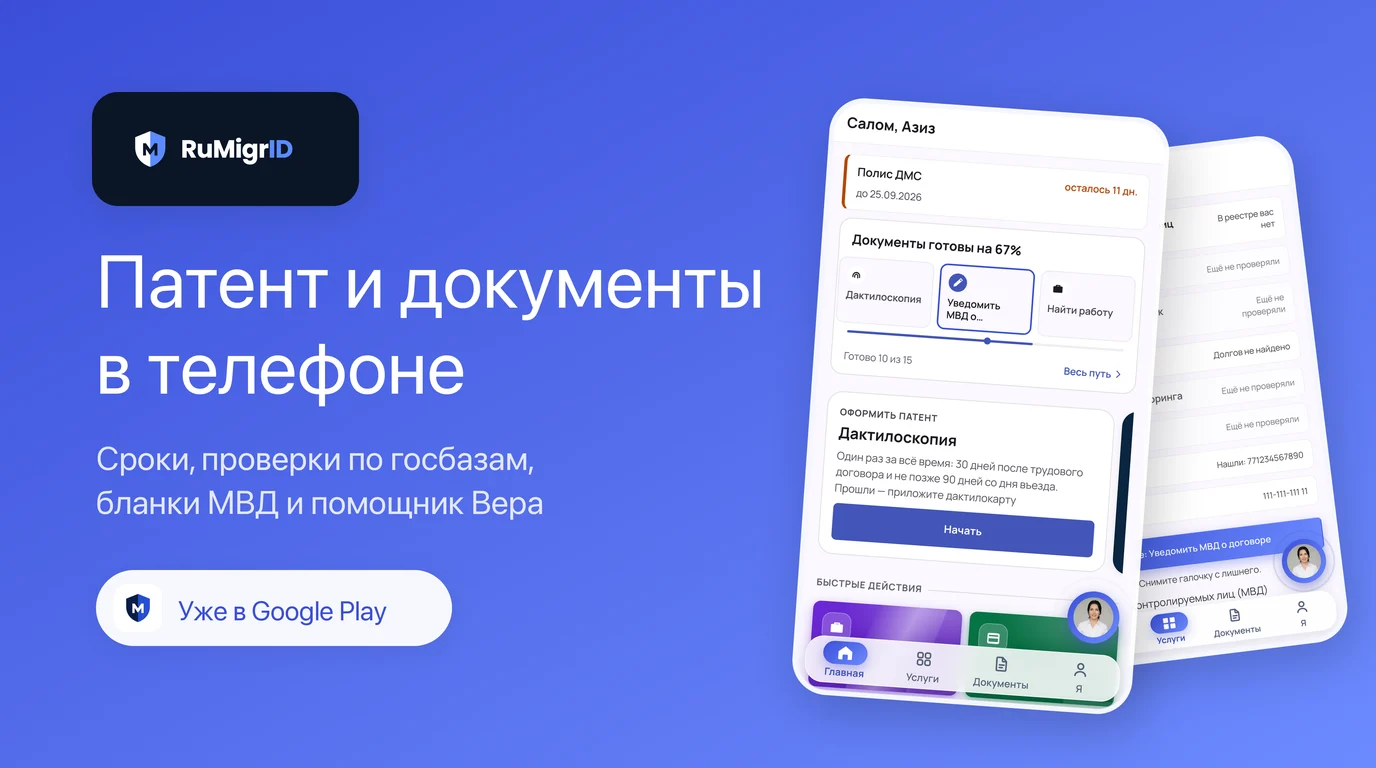
RuMigrID: a foreign worker’s documents on their phone
Ministry of Internal Affairs notifications and applications are completed using the employee’s data, documents reach you via QR code, and you learn about the work permit deadline before the day of an inspection. The RuMigrID app is now on Google Play.
Read →
AI Skills in Job Postings: How to Set Up Hiring
A study by Avito Work («Авито Работы»), a Russian job-search service, and the chad neural-network marketplace shows a connection between requiring AI skills in job postings and higher pay offers.
Read →
How to Plan Hiring Amid a Labor Shortage in 2026
The hh.ru study reported by RIA Novosti (РИА Новости) can serve as a reference point for a company’s hiring plans. However, market demand does not replace a separate candidate assessment and immigration screening.
Read →
Hiring Workers from Afghanistan: What to Consider
There is still no confirmed mechanism for the organized recruitment of workers from Afghanistan to Russia. Companies should base recruitment on the rules currently in force and verify each candidate’s status.
Read →
Wage Arrears in Krasnodar Krai: How Employers Can Reduce Risk
In 2026, enterprises in Krasnodar Krai repaid nearly RUB 982 million in previously identified wage arrears. Regional authorities intend to identify the risks of new arrears earlier and work with employers on a targeted basis.
Read →
7 Million Fine for 58 Foreign Nationals Without Permits
An entrepreneur in Samara Region was fined 7 million rubles after 58 foreign workers were found without the permits required for agricultural activities.
Read →
Afghan Workers: Why Not to Include Them in Workforce Plans
Russia is not making practical preparations to recruit migrant workers from Afghanistan. For employers, this means that a separate organized recruitment channel cannot be included in near-term workforce projections.
Read →
Quotas for Foreign Workers: Ministry of Labour Proposes
The Ministry of Labour draft concerns regional limits on the permitted share of foreign workers. While the document is under discussion, employers should assess its possible impact on workforce planning.
Read →
Construction Salaries: How to Retain Scarce Crews
On the construction labor market, higher pay is becoming a tool for retaining workers, but it is not a universal solution for every position. Employers need to identify scarce crews, compare total earnings with the market and address the reasons workers leave a project.
Read →
Resignation by Email: Rules for Employers
An ordinary email should not automatically be treated as a resignation. An electronic resignation can be processed within personnel electronic document management and under the rules established by the employer.
Read →
MFA on Hiring Foreign Nationals: What Employers Should Check
The MFA statement does not introduce new rules, but it emphasises lawful employment, digital procedures and countering “grey” schemes when hiring foreign nationals.
Read →
Deportation for a Dangerous Infection
The State Duma reported that a law allowing the deportation of a foreign national diagnosed with a dangerous infectious disease had taken effect. The procedure for applying the rule has not yet been disclosed in the original publication.
Read →
Extending a Foreign National’s Stay: Employer Actions
The Ministry of Internal Affairs’ clarification introduces no new rules but helps employers organize oversight of employees’ stay deadlines, roles, and applications.
Read →
Organized Recruitment of Foreign Nationals
At a meeting of Russia’s Ministry of Internal Affairs, organized recruitment of foreign nationals was identified as a priority area. No new rules have been announced yet, but employers should review their existing processes.
Read →
Which Foreign Nationals May Be Engaged as Professional
The professional income tax regime is available to citizens of Armenia, Belarus, Kazakhstan, Kyrgyzstan and Ukraine, provided they meet the requirements of part 3 of Article 5 of Law No. 422-FZ.
Read →
Russia Prioritizes Organized Recruitment of Foreign Workers
At a meeting of Russia’s Ministry of Internal Affairs, organized recruitment of foreign workers was named as one of the priorities. No new obligations or deadlines for businesses have been announced yet, but employers should review their existing processes.
Read →
Blacklists and the Legal Hiring of Foreign Nationals
A public statement about the role of blacklists does not introduce new rules, but it draws employers’ attention to the risks of informal staffing arrangements.
Read →